Some of the most consequential business conversations do not begin in a boardroom. They begin around a table.
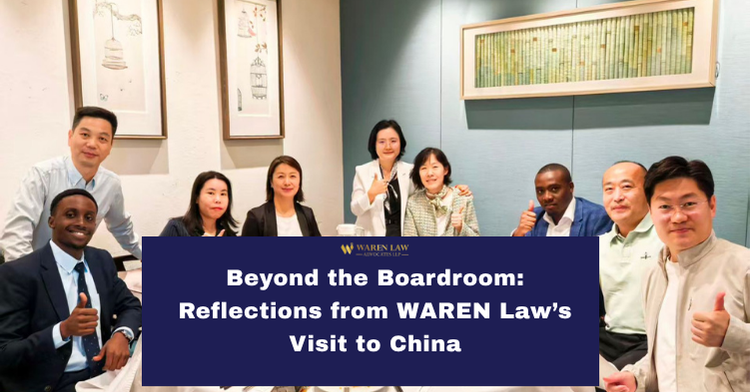
During my recent visit to China, I sat down for lunch at Crystal Jade in Beijing with partners, business contacts, and friends.
Dishes prepared with the kind of intention that tells you, before anyone says anything, that this is a culture in which time, hospitality, and seriousness are not separate things.
Outside, Beijing carried the early warmth of spring. Inside, the conversation moved from food to family, from family to investment, and from investment to a question I have been thinking about ever since: “What does it actually take for Kenya and China to build the kind of partnerships that hold up under pressure: commercial, regulatory, and political?”
The answer, in my view, is better structure. And structure is where most cross-border investment into Kenya goes wrong.
Energy: the conversation Kenya cannot afford to keep losing
The first substantive theme on the table was energy, and specifically solar.
Reliable, affordable energy is no longer a development ambition. It is a precondition for everything else: manufacturing competitiveness, digital infrastructure, agricultural processing, hospital systems, and the kind of business environment that retains talent rather than exporting it.
Kenya’s grid story is well known. We have made real progress in renewable generation, particularly geothermal, but the cost of power to industrial and commercial users remains a serious drag on competitiveness.
Solar, at utility scale, at commercial-and-industrial scale, and increasingly through captive arrangements, is one of the most credible answers to that problem.
The opportunity is real. So is the gap between opportunity and execution.
I have watched promising solar projects in Kenya stall because the legal architecture underneath them was assembled too late.
A serious solar project in Kenya touches at least the following: site control under the Land Act and, where relevant, the Community Land Act; environmental authorization through NEMA; generation licensing or registration with EPRA; a power purchase agreement with Kenya Power or, for captive arrangements, a properly structured wheeling or direct supply arrangement; county-level approvals that are often underestimated; and tax structuring that has to anticipate VAT treatment, withholding obligations, and capital allowances under the Income Tax Act.
All of it is non-negotiable. And almost all of it is best resolved before the first large commitment of capital, not after.
The Chinese investors I spoke with understood this instinctively. China’s own energy build-out was delivered through planning, sequencing, and execution discipline. The question they were asking, and the question Kenya must be ready to answer, is whether our regulatory environment can match that discipline on the inbound side.
Mining and the value-addition question
From energy, the conversation moved to mining.
Guinea came up in the context of iron ore. The DRC came up, as it often does.
These are the jurisdictions that dominate the global conversation about African minerals, and for understandable reasons.
Kenya is rarely discussed at the same volume. That is partly because our extractive sector is younger, and partly because the international narrative about African mining has been shaped around scale rather than strategy. But Kenya’s position deserves more careful attention than it currently receives.
The more important question, in any case, is no longer whether Africa has resources. Everyone knows the answer to that. The question is whether extraction translates into value addition, industrial development, and durable national benefit or whether it remains a model in which raw material leaves and finished goods return.
This is where the law does serious work, or fails to.
A mining project is a network of legal relationships: between investor and government under the Mining Act, between investor and community under the Community Land Act, between operator and financier under project finance documentation, between exporter and host country under fiscal and royalty regimes, and between commercial partners under joint venture and shareholders’ agreements.
When any one of those relationships is poorly structured, the project becomes vulnerable to dispute, delay, reputational damage, or quiet loss of value through the back door of weak governance clauses.
When all of them are well structured, the law stops being a compliance tax and starts being a development instrument. It becomes the mechanism through which a mineral asset converts into local employment, infrastructure, technology transfer, and tax base. That conversion does not happen automatically. It happens because someone wrote it into the agreements and someone else made sure those agreements were enforceable.
This is the conversation Africa and China should be having more often, and at greater depth. China brings execution capacity, capital, and industrial know-how.
Kenya brings opportunity, location, regional integration through the EAC, and a legal system that operates within a constitutional framework that international investors can model.
The bridge between the two is built by lawyers, regulators, financiers, and operators who treat structure as the foundation, not the finishing touch.
What investors entering Kenya consistently get wrong
If I had to summarize what I see most often in cross-border investment into Kenya, it would be this: investors arrive with a commercial thesis and assume that the legal work is the last twenty per cent.
A few of the patterns that recur:
The wrong local partner is selected on the basis of social proximity rather than legal due diligence, and the consequences only surface when the project hits its first stress test.
Land is treated as available because it appears uncontested, when in fact community land consultation requirements have not been completed, succession on the title has not been resolved, or county-level interests have not been engaged.
Joint venture documentation is borrowed from another jurisdiction without being adapted to Kenyan company law, with the result that minority protections, deadlock mechanisms, and exit rights do not function as the parties assumed.
Tax structures are designed for the holding company jurisdiction without adequate attention to Kenyan withholding tax, transfer pricing rules, and the practical reality of repatriation.
Regulatory timelines are treated as predictable, when in fact they require active management across multiple agencies that do not always coordinate.
None of these are exotic problems. All of them are preventable. The investors who succeed in Kenya are the ones who ask better questions before they enter, choose partners with diligence rather than enthusiasm, and bring legal structure into the room early enough to shape the deal rather than ratify it.
Why these conversations need to keep happening
The lunch in Beijing was, for me, a reminder that the most useful Kenya-China conversations are not the ceremonial ones. They are the ones in which lawyers, investors, regulators, and operators speak candidly about what works, what fails, and what needs to be designed differently.
Those conversations are still too rare. Most Kenya-China engagement happens at one of two altitudes: either at the level of high diplomacy, where the language is general, or at the level of individual transactions, where the focus is narrow. The middle layer, where serious sectoral and structural questions get worked through, is underdeveloped.
That is the layer WAREN Law is interested in helping to build. Because it is where the work actually gets done.
The role of the lawyer in cross-border investment
There is an assumption that the lawyer’s role in an investment is to paper the deal once the commercial terms have been agreed. That assumption is the source of more avoidable loss than almost any other factor in cross-border investment.
The right time to bring legal counsel into a Kenyan investment is before the structure is chosen, not after. Before the partner is selected, not after the LOI is signed. Before the land is committed, not after the deposit clears. Before the regulatory pathway is assumed, not after a stop-work notice arrives.
Counsel, used properly, is not an expense line. It is the mechanism by which an investor’s commercial intent survives contact with regulatory reality, partner behaviour, community dynamics, and the inevitable surprises of a long-cycle project.
That is the role we are interested in playing for Chinese investors, for Western investors, for diaspora capital, and for the Kenyan operators who are increasingly building at a scale that demands the same discipline.
What I took home
What I took home was a sharpened conviction that Kenya-China investment, done well, requires three things at the same time: capital that is willing to be patient, structure that is built to be durable, and cultural understanding deep enough to absorb the misunderstandings that will inevitably arise.
Kenya is not a frontier market in the casual sense of the term. It is an increasingly structured market, and serious investors deserve legal partners who can help them navigate that structure.
That is the work ahead. The trip to Beijing made me more interested in it, not less.